Sunday, June 19, 2016

Sua voce era un bisbiglio

Patrick declared a new record yesterday afternoon as he returned from a hectic tour of Pavia: eight churches, one cathedral, and three masses. We have very different ways of experiencing a city.
The must-sees of a city aren't necessarily must-sees for me. I prefer to walk the gardens, the back alleys and the leafy boulevards. I'll ask directions even if I know I am close or ask what interesting sights there may be to see even if I already have an inkling, just to interact with the people, to find the rhythms of the place. At the University of Pavia, one of the oldest in Europe. I walked through ancient cloisters, entered empty classrooms. I chatted with students about what was special there. 
I strolled down rounded-stone cobbled streets under spreading boughs, making eye contact with people walking their dogs, experiencing the city's hospitality. One man, seeing my backpack and the map I was holding, guessing correctly that I was a pilgrim, asked if he could help. I told him I was looking for San Pietro in Ciel d'Oro where the relics of Bothius lay and Saint Augustine is buried, the church mentioned in Dante's Divine Comedy, Canto X. I knew I was close. I didn't really need his help. But he insisted and left his car running to walk me along the street to the church's entrance. This is the way I love to see a city. 
At San Michele Maggiore, a docent, one of two, approached me. Again it was evident I was a pilgrim. I'd like to show you something," she said. Sua voce era un bisbiglio. Her voice was a whisper, her movements a meditation, and there was no better picture of tranquility than she. Valerie spoke to me in a fluent but accented English, stopping only occasionally to ask how this or that might be phrased better than she thought herself able. I asked if she was Italian. She said she had lived here twenty years, but she was born in Germany and lived in Africa. An unspoken "it is complicated" seemed left dangling in the air. 
She walked to the high alter and unlatched a gate. I followed. We climbed up a few stairs to where Barbarossa has been coronated and Lombard kings acclaimed. The pattern on the floor was interrupted by a roughly five by three meter tessellated rectangle which had laid hidden beneath the alter until it was uncovered when the alter was moved toward the rear of the apse. "It is from eleven twenty, or would you say eleven hundred and twenty in English?" I replied that either would be fine. 

In each of eleven squares a human figure was engaged in the activities associated with the month written in Latin, from February to November, plowing, sowing, reaping, and the central figure, the king of all the others, ANNUS on his throne. January and December were missing, destroyed when the floor decoration was relaid with a regular, repeating, non-pagan motif, except for this remaining section, the part protected by and lying hidden beneath the alter for centuries. Below the representations of the months, there was a chord segment that depicted the upper fourth of a spiral labyrinth, a circular pilgrimage.

In the two triangular corners with arced hypotenuses abutting the round labyrinth on left and right, partial figures represented earth and water. In the corresponding lower sections would have been air and a dragon representing fire. A document in the Vatican library describes the complete design.

"There is something older I would like to show you." I followed Valerie as she floated down the stairs. She let me pass, latched the gate and guided me to her left. A golden Christ I guess to be six feet in height but not otherwise of human proportions spread across a gilded wooden cross. A long thin face, spaghetti hair in parallel strands and spindly-thin and stretched looked vaguely like a work by Giacometti gave the figure a modern look. "It is more than a millenium old, from about the year 900," Valerie added. As an objet d'art it was wondrous. Others are better suited to comment on it as a object of devotion.
I would have enjoyed another day in Pavia, sitting in cafes that shared centuries old church courtyards, wandering through ancient buildings repurposed for trade but retaining medieval architectural elements, watching and interacting. Extra days seem somehow hard to manage. We had checked out of our room, our packs were on our back, and we had a day's walk ahead of us. We left Pavia for the small town of Belgioioso where we enjoyed the hospitality of Signora Mara Baldini, a kind and giving woman, who made her lovely maisonette, complete with courtyard, garden, and fully stocked kitchen available to us on a pay-what-you-can-afford basis. 
Two days later we crossed the Po the traditional way, by small boat from ferry landings that connect the old Roman road, loaded with pilgrims –Claudio and Mirella, who we caught up with the day before, Marco, who we met and have been walking with for a few days, Patrick and me – our packs, and a boatman who for years has been registering the names of pilgrims he has carried and stamped their credentials. Tonight I rest in Piacenza, the first of Rome's military colonies and tomorrow I start making my way to the hills and mountains that eventually lead to the Toscano.

Comments welcome here or at garyontheway@gmail.com
Thursday, June 16, 2016

Tutti cappelli.

A quick post to thank my friends who expressed concern and offered advice regarding my knee. I heard from the Wife of Bath and a friend who is a doctor. The sagest, most pragmatic advice came from a good friend of thirty years who wrote: "Don't make your knee any worse if there's any risk! You can contemplate your soul with a healthy knee." Tutti cappelli." Hats off!

Wednesday, June 15, 2016

il problema con mio ginocchio

Can you strain your meniscus without tearing it? I don't know but something whacky is going on inside my right knee. For two days it was hard to put weight on it. Every time I had a downslope to navigate, I had to step with my right leg and bring my left even with it, taking baby steps, or old man steps as Patrick with his sometimes sharp wit commented. Upslopes and flats were fine, no problem, but anything more than the slightest downslope, anything requiring an angle between my right lower leg and the upper was more than modestly painful. I felt that the knee would not support my body weight.
I have it managed now, thanks to ice packs every evening, two ibuprofens each morning and several days of predominantly flat terrain, but the knee hasn't been retested. There are still a few days on the Piedmont and Lombardy flats, walking for hours on the mud dams separating rice paddies, soon-to-be-risotto all around me, for miles! I won't be on hills again for another week. When I was going through my second cut at packing before leaving California, winnowing down weight, a snakebite kit here, a mylar emergency blanket there, I held my knee brace in my hand and considered it. If I had not been experiencing sciatica, if I had not felt my body a bit vulnerable, I would have left the knee brace at home. But I took it. It was my savior for four days until the backside of my knee was rubbed so raw the chafing became more of a problem than my slowly improving knee.
But the day I left Aosta started out on a high note. I met Claudio. Patrick spotted two figures with backpacks across a traffic circle as we were leaving the center of Aosta. A large monument at its center, leafy sidewalks on both sides of all six spokes, the Italian participation sport of aggressive lane changing at high speed was in full swing. We managed our way across. When Claudio spotted us his face opened into a large welcoming grin, his grey ponytail sailing to the right as he swiveled his head left in our direction. Claudio is the kind of person who leans into you when you converse, not in a threatening way, but in anticipation, anxious to participate, eager to enjoin the conversation. He is not a very tall man, but he has a big stride, in his early-sixties but has a hidden energy that could come pouring forth at any moment if he fails to restrain it. Mirella, his wife, was with him, on her first long-distance walk. Claudio and I chatted along most of the morning in broken Italian and broken English, a mongrel tongue that anyone trying to listen in would have difficulty comprehending. We were doing just fine though. Mirella contributed where she could.
I started the conversation with the same expression I use in every language I know a smattering of, "Non parlo multo Italiano ma provo." It works wonders when you tell someone in their own country that you don't know much of their language but you are going to try. If the conversation turns immediately to introductions and the introductions include where you are from, they are doubly astounded to find out you are American. It is just not what they expect and you've broken the ice in a very big way. If you are lucky enough to live in a place they have a positive image of, like San Francisco, a place that is on almost everyone's bucket list, you get eyebrows lifted, a big smile and a "Ahh, San Francisco." Once you confirm you are all pellegrini, there's a good chance you have a walking companion for at least a few hours, maybe days. The conversation turns quickly to where you are headed, for the trip and for the day, whether and how many times you've walked to Compostela, which routes you've taken, where you started this pilgrimage and when. Those are the preliminaries. It's the secret handshake. We are a brother/sisterhood, a community. It does not matter the nationality, the faith, the social class, the political outlook, the line of work, the age.
Sigerac the Serious, the Bishop of Canterbury who documented the Via Francigena in the last century of the first millennium, followed a route that is in some dispute. I believe that the only thing that is know for certain are the places he stopped each day of his return journey from Rome. If I had to guess, after reaching Aosta, Sigerac would have taken the Roman road which followed the river near the base of the valley, high enough to stay passible in times of flood. The Roman road I walked on last year had been covered over with gravel. This one was the original, the same stones Roman legions marched over and Roman suppy wagons cut ruts into.
Today, the base of the valley is traversed not only by the river, but also by the modern version of the road to Gaul, the superstrada, the highway whisking auto and truck traffic from the Val d'Aosta to the Piemonte and beyond, and by roads that permit access to the towns that line the base of the valley and the lower reaches of those towns that are built on the hills that slope up from it. Today's Via Francigena connects the places that are documented by Sigerac's scribe, but the route between those sites are not known exactly. Where there are extant portions of the old Roman road, you can be pretty sure Sigerac traveled over it. 
The roads today's pilgrims walk are designed to keep them off busy thoroughfares, opting instead for country roads, dirt tracks through woods and fields, and cobbled paths that connect evocative hamlets and villages, especially if there are interesting churches, towers, or castles to be visited or viewed, any sites that pilgrims or hikers might be drawn to. In this region, in the foothills of the Alps and along the longest moraine in Europe, that means climbing and descending. 

On this particular day there was nothing to match the descent from the Col de Grand Saint Bernard we had just accomplished, but enough to make you work. It was not that the elevation changes were so great, only that they were steep, both up and down. In between three notable sections, there were many smaller ascents and descents so that by the time we got to the last climb of the day, I felt that I was in serious trouble.

My knee started hurting on the first descent. We had attacked the upslope with aplomb, making good time, winded but strong. A flat sectioned followed and Claudio and Mirella stopped for something to eat from a plastic bag Claudio had been carrying since we met him in Aosta. Patrick and I continued along. When we started down, I was very surprised that my knee was hurting. I had no prior indication that there was anything amiss. The damage likely had been done on the two days of long descents from St. Bernard to Aosta. This first significant downslope of the day did not do the damage. It just made it evident. 

We decided to stop for lunch and headed down off trail into to find a restaurant. After we finished, we needed to regain the height we had lost. Again we attacked, taking the full elevation change without slowing and without a rest. We found Claudio and Mirella again, they were sitting in the shade outside a church. Mirella had blisters and her feet were hurting.
Walking together for the remainder of the day, we passed by the home of a Romanian gentleman, eighty years old, mind sharp, body giving no indication of slowing down. He had worked for sixty years in the US and when it came time to return to Europe, the only place he was going to go was Italy. He showed us his woodcarvings – they adorned the side of his home abutting the trail. We spoke for about ten minutes. He asked us in for coffee but we declined.

The longish stop was a bad idea. My knee had stiffened and every step was painful. Claudio asked what was wrong and when I told him he asked if I wanted to stop. I said no and he gave me a "bravo!" There really was no choice, no way to bail off the trail. Where would I go? Patrick suggested I take the lead to set a pace comfortable for me.

Some people walk with head erect, surveying the landscape. I generally walk with my head somewhat bowed, glancing ahead at the trail a few feet in front of me. I think it is because I am often deep in thought. So it is not totally surprising if I miss a turn or a trail marker now and then. I think I do it more than most. When we found ourselves ascending between two old abandoned stone houses, roof shales and stone blocks that had been walls scattered and covering what we thought was the trail, cantilevered so that stepping on one side lifted the other and your boot sank, brushing against discarded shale stones, we knew we had lost the trail.

Patrick suggested retracing our steps, but by that time I was not going to go down when I could go up. The pain was too great. So I volunteered to forge ahead and retake the Via Francigena, which my GPS indicated was twenty or so meters above us. Once I cleared the stones, I pushed through deep ground cover, bushes, and high grasses. Finally, I saw a clear trail above me. Calling to the others, I forged ahead. We did eventually have to head down into the town at which we would be staying that night, Chatillon. I was in bad shape and asked the man who greeted us at the restaurant/albergo for a bag of ice.
As I spelled out in the opening to this post, I am now a number of days past. Some of those days included lesser climbs and descents, but anything past a minimal downslope was difficult for me. The first of those next days were very problematic, but as we hit the flats, and there are days and days of them past and yet to come, my knee, helped by two ibuprofens in the morning and icing in the evening, settled down. The first really significant climb and descent will not be for another week. I'll try to baby my knee until then.

Sunday, June 12, 2016

Cinquanta sfumature di grigio

I'm stuck. I've written and rewritten this post a half dozen times. I just can't get it out the way I want. I know why. There are recent events on my mind, way too personal to share. Yet they keep intruding into the post I want to write. If I do not get it out, I won't be able to move on to the rest of my journey and the problem that almost derailed it just three days in, an issue that remains on day eight, something I have to carefully manage. The only solution is to just get something on paper (an old cliché), not the event that is bothering me, but some reflection of it, some generalization. I ask your indulgence (a very appropriate concept for pilgrimage) if this post lacks the coherence and cogency I usually strive for.

I was inspired by the stark picture of the snow and ice covered Alps included with my last post to photograph this journey in black and white. On prior walks, I have photographed in color and then post processed some of the images to B&W. A few of those are among my favorites. But photographing directly to B&W is different – you have to see in black and white. Though you expose for the blacks, your real interest is in the expansion of those luscious mid-tones, the grays that give B&W photos their compelling aura, that sense of near but not perfect reality, the essence of those pictures that make dwell over them, far longer than you might with a color photo. Cinquanta sfumature di grigio? Fifty shades of gray? Far more. 

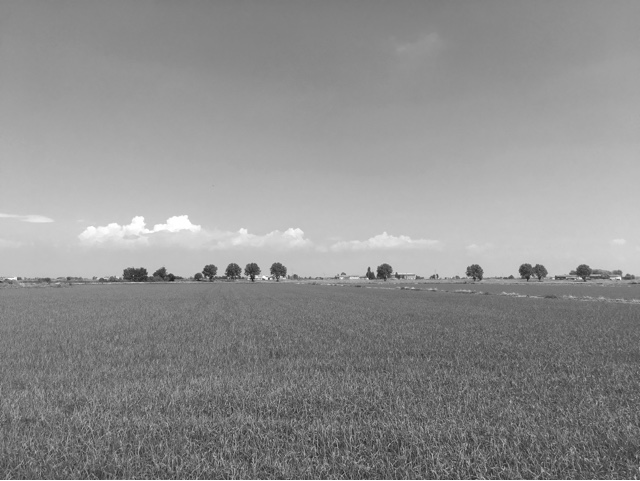
A B&W photo takes work. A field of white and yellow wildflowers will all go to the white unless you consciously expand the range of grays between them and allow the grass on which they sit to go black. I am not saying that the photos included here are great photos, only that the process of photographing in B&W requires a special discipline that reminds me of the thought processes I engage in while taking these long walks. 
As I began my second day's walk, from Echevennoz to Aosta, I thought about the similarities between my journeys and photographing in this way. From the trattoria in which I stayed, a small climb brought me to a relatively flat track that followed an irrigation channel dating from the 12th to 15th centuries. There have been modern improvements of course, metal conduits, PVC pipe, rubber hose, but mostly, over the course of dozens of miles it is a hand dug channel lined by flagstone or just earth, losing only a few meters in elevation over its length, delivering runoff, stream and river waters to fields all through the Val d'Aosta. 
Photographing in B&W takes time. You can't just pick up the camera, frame and snap. You have to think about which of those gray tones you want to bring out. You begin to think about pulling the scene apart, which textures you want to emphasize, which you want to push to the background. If you place too much white next to a texture you want your viewer to focus on, their eyes will be pulled away to the lighter sections of the photo. And so it is with much of my thinking during these walks. I am often pulling apart events recent and long past, trying to see the gray tones, recognizing that the images I retain of those events may not be all that there is to them. I begin to see the texture within the picture, the contributing factors, how my own actions may have motivated others and thus created the events I am considering. The picture I come away with is often different than the one I held in my memory. It is an image of the same thing, but it has more to it, more tones, more subtleties. And when one is thinking about the interaction among people, the expansion of the mid-tones can give the entire event new meaning.
I left the course of the irrigation channel and descended towards Aosta. Entering Gignod, Patrick and I came across a lovely anziana who was convalescing in the parish house across from the church. She invited us in for a look at the garden, and a view down the Val d'Aosta. As my walking continued, so did my thoughts. I found myself thinking about forgiveness forgiveness, a concept I frankly have difficulty with. I've been able to push things to the background, not forgotten, but to a place where they no longer cause the pain they once did. Have I forgiven? I've discussed the concept with my friend Marc, a man of strong faith. He, too, has some difficulty. He thinks of it much in the way I do. My good friend Dinesh says I should not worry so much about the past: It is unchangeable. He urges me to focus on the future, that which I can affect. It is advice I would like to be able to follow.
Every once in a while, despite the neat little places I've tucked some remembrances, those understandings that include the mid-tones, the textures I've been able to tease out of the background, another event occurs that bring them back to the surface. I guess I still have a way to go.
Patrick and I continued on to Aosta, a pretty little city, nestled at the foot of the mountains, at the high end of the valley. By the time we arrived, we had lost about seventy percent of the elevation from the point at which we started. Again, I felt the burn in my quads, and this contributed to the problem I will tell you about in the next post. Patrick had a look around town and we met up in the main piazza for a coffee and a gelato. We had a good discussion on issues important only to the two of us and a nice dinner at a craft brewery before dodging raindrops back to the hotel.

While this day had been a day of mid-tones, the next day would be about extremes, the white and the black.

Comments welcome here or by email to garyontheway@gmail.com

Friday, June 10, 2016

Cominciare

I am five days into my walk and it is time to bring you all up to date, or as far as I can get in one sitting. Since this is not really a touristy blog, I do not feel obligated to give you a day by day, blow by blow description. But I've already travelled some seventy miles (about 125 km) into Italy and descended some 6,000 feet (2,000 meters). I do feel obliged to give you something. I did, after all, invite you along.
When I arrived at the Hospice Saint Bernard in Switzerland, about 100 meters from the Italian border, it might have been late winter instead of late spring. The pass had just been cleared of snow, a few days later than usual. The mountain-scape white. I recalled the photo from last year's final post, me atop the pyramid marking the highest elevation of the pass, blue sky, mountains dotted with snow, the lake reflecting it all. There was no sign of the pyramid this year. It is still there, just buried under ten feet of snow.
Though the pass had been cleared for vehicular traffic, the mountain path descending down to Aosta, 20 miles distant, was not passable at the highest elevations. Brother Frederic, the chief hostelier, recommended we descend on the road for a mile or so, until we passed an Enoteca. There, he said, the footpath would be clear enough for us to use. So Sunday morning, the fifth of June, Patrick and I bundled up with as much warm weather gear as we had, which was none, and braved the mid-thirties temperatures, about 3C, and blustery wind, and set about the start of this year's journey. I was in a polyester T, hiking sweater, and summer weight hiking pants. It is Italy in June, after all, and carrying additional weight for just a few hours of comfort didn't make much sense as I sat at home in California packing.

So I brrrr-ed my way down to the Enoteca, stuck my head in to ask whether the path was clear below, more to test whether the money for a few Italian lessons had been well spent than for any other reason, and took my first steps onto the mountain. We, Patrick, my friend with whom I walked last year, and Paul, an architectural photographer from London, traversed two narrow snow fields, and greeted late spring with pleasure.

In one of those coincidences common on these ancient pilgrimage trails, we had met Paul just more than half way into last year's walk. He is doing the Via Francigena (VF) as he can and was walking more lengthy days than Patrick and I. So our paths crossed for just one night. He ended a few stages before we did, and started this year's hike a few days before. As Patrick and I were having a coffee and hot chocolate in the Albergo across from the hospice the night before we started, Paul came up to the table and asked, "Don't I know you two from last year?" Yes, indeed!
So the three of us descended a quad-burning 1,000 meters together, Patrick and I planning to take two days to Aosta to accommodate my jet lag from the flight I had taken just the day before, Paul heading all the way to Aosta. The path did not waste much effort wandering across the mountain. It was mostly straight down. Brown turned to fields of wildflowers and then to grass and scattered woods as we made the tree line. Water that was ice just hours before tumbled across the trail. It got pretty hot. We shed sweaters and lost all thought of the gloves and other gear which, just an hour before, we had been wondering why we did not bring.
Trail signage was generally easy to follow. We only made one mistake and knew it when we ran into a skull and crossbones, a sure sign not to proceed. But we easily regained the VF and made it to Etroubles, just a few km before our day's destination, Echevennoz. Patrick and I stopped for lunch and Paul headed on to Aosta. He will be stopping in Lucca this year, we a few stages behind that. But it will come as no surprise if we run into him next year as we make our way to Rome.
The first day of walking is not really a thinking day. You are evaluating how your pack sits, how your boots feel, generally how the physical part of your preparations are playing out. Before heading out that morning, I had been quite concerned about the sciatica I had been experiencing before I left California and, of course, my feet. You who have followed me, either in my blogging last year, or in my stories from the prior six years of walking various trails to Compostela know that I have had really bad luck with blisters. My toes have not completely healed from last year's walk, lost nails not completely regrown. Though some blisters would pop up in the next few days, it was something else entirely that would assert itself and make my walk problematic. On this first day, though, other than the sore muscles from the steep descent, I felt fine.
Patrick and I stay in hostels, parish houses, monasteries, B&B's, hotels, restaurants with guest rooms, in dormitories or double rooms (letti separati, certo!), whatever works for our needs on the particular night and depending on availability. At the hospice, it was a 12 bed dormitory; in Echevennoz it was a double room in a bar/trattoria. 
The evening was one of good cheer as we dined with five French pilgrims, one man, Philippe, four women, two Genvieve's and two Isabel's, who were walking together for a week, and with Helen, from the Netherlands, who started in Belgium in May and expects to make Rome in August. We had met and dined with all six the evening before at the Hospice. This evening over spaghetti, veal in beef ragu, and red Val d'Aosta wine, there was that special 'Camino' ambiance as we got to know each other better, mostly in French and a bit of English, traded stories and asked really personal questions such as from one of the two Genevieve's at the table who was embarrassed to ask me whether men are like women and attach their not yet dry underwear to the outside of their packs so they dry in the next day's sun. Certamente!
I will leave it there for now. The next day was more of a thinking day and I'd rather start that as a new post.

Comments and hello's are welcome, here or by email to garyontheway@gmail.com

Thursday, May 26, 2016

L'avventura a piedi continua

Yes, that is Italian. I've been preparing for this year's walk with, among other things, a short course in elementary Italian to make getting a bed, a meal, and other of the road's necessities, a little less difficult.  It will be far from perfect, perhaps only barely comprehensible, but hopefully good enough.

That is how I am feeling about a number of things this year. I always start off thinking that the portfolio of little aches and pains I've been accumulating will fade into the background as my body accustoms itself to the pack load and the miles of walking. Generally that's been true, but this year I will be starting off with some of last year's foot problems still unresolved, a returning case of medial epicondylitis (don't panic - just golfer's elbow), and a nagging sciatica. Well that's what another year will do to you. But hopefully, I'll hold together well enough.

Not solely because of these little complaints, the walk from Winchester, England to Rome will take a year longer than originally envisioned. Last year's approximately forty five days and 750 miles got me and my friend Patrick to the Col du Grand Saint Bernard, just about 100 meters from the Italian border. That walk was too long, too rushed, and too many miles per day. So, whereas the original plan was to do an equivalent hike this year ending in Rome, I've convinced Patrick that we should take an extra year, maintaining an average daily distance closer to my preferred eighteen miles (thirty kilometers). With no set endpoint other than the necessity of making my flight home, it doesn't really matter how far I make it along the Via Francigena this year in the three or so weeks I will be walking. I expect to get somewhere between Parma and La Spezia, about 400 miles from the Saint Bernard pass, but a little less will be just fine.

This is, after all, Italy. I hope there will be days where I prefer to linger than to walk. If there are, then faró niente, I'll do nothing but explore some little village, meet some interesting people, and meditate on "life, the universe, and everything." No, Douglas Adams is not on my iPhone, but Matsuo Basho, Joseph Conrad, and Belden Lane are.

As last year, if it can be arranged, I'd like to see some friends, Colleen, l'artista eccezionale, and her husband, now residing near Alba, and Giorgio, il pellegrino molto dedicato, whom Patrick and I met last year, the day before we arrived in Besançon, and who I've arranged to meet in Vercelli. Giorgio was one of the very few pilgrims we met last year and the only one we reconnected with on at least a few days. I expect and hope we will meet more walkers this year, the Italian section of the Via Francigena more established as a contemporary pilgrimage route than are the sections through France and Switzerland.


As Kathryn, a wonderfully knowledgeable professor at GTU in Berkeley reminds me, Chaucer wrote that April is the month in which folks' thoughts turn to pilgrimage. In my case, I've been thinking about this year's walk almost from the time I returned from last year's. Rumination turns to reality at the beginning of June, a week from Sunday.

Thursday, July 9, 2015

Veni, Vidi, Cogitavi

I came to walk. The path I chose was from Winchester to Col du Grand St. Bernard, and next year from there to Rome. Though I am roughly following the roads walked in the tenth century by Sigeric, the Archbishop of Canterbury, I am also wandering through a personal history of events, relationships, and self-perceptions. Sometimes this interior journey takes precedence over the physical one. Sometimes it is the other way round. I guess the two are always interacting in a way that helps me to understand myself better. 

I saw places I had never been and some I had seen before. I saw friends and renewed friendships. I made new friends, even though our encounters were brief and the chances of ever seeing them again are low. If ever I did, I am certain they would act as friends. That's just the way it is when you meet fellow pilgrims, when you share meals, when you clasp their hands to say goodbye, and the clasp turns into an embrace, and you brush your cheek against theirs, and you feel a wind weathered face or a scruff of beard a few days older than it would be if you had not met on the road.

I thought about those people, not everyone, of course, but those with whom the encounter was more than passing. I thought about certain events and how I reacted to them, because they help me understand myself better. I know I will reflect more deeply on them as time goes by.

Monday I walked a path that was physically challenging and my reaction at its completion was entirely predictable, though I did not think about it in advance. I have learned some things about myself on previous walks and it is comforting to know that those insights have predictive capability. I won't share everything with you. I can't. Some things are just too personal, but I do want to tell you about the hike, though I first owe you some closure on the day before.

Between Martigny and Sembrancher, the section advertised as dangerous with vertiginous drops on one side, the journey was that of a rational mind confronting a perhaps irrational fear. I made a mature decision: I took the train. 

Patrick did the walk and I met him in Sembrancher to continue together to Orsières. Of the 8 km, 5 miles, I did not walk, only a few hundred meters, less than a quarter of a mile, might have given me trouble, though Patrick reports that there is now a cable stretched along the offending section. He thinks I could have managed. He might be right. He's been walking with me for well over two thousand kilometers, almost thirteen hundred miles, taking into account the portions of the two walks to Compostela we did together and this year's trek. His brand new iPhone 6+ has taken one too many pictures of churches, cows, and lavoirs, and refuses to take any more, so I have no photos to judge. But I am content with my decision. It shows that, at least on this issue, I have a good understanding of self.


The remainder of the day's hike was picture postcard Swiss. The tourist board would be proud. We climbed several hundred meters to quaint villages and then descended to Orsières, where we would stay the night before beginning the climb to the St. Bernard Pass the next morning.

We did our homework. In preparation for the next day's difficult hike up to the hospice established by Bernard of Menthon around 1050, a climb of 1800 meters, one mile elevation change, over a distance of 30 km, 18.5 miles, we went to the tourist office to check out weather conditions and the expected time to complete the ascent. The office was closed. Not too much was happening in Orsières on an almost 100°F Sunday afternoon. But the ticket office at the train station was open and we received sage advice. With regard to the weather, "God knows. It can be anything." And the duration, "Never did it. Most people leave from Bourg St. Pierre. Maybe ten hours from here to the top."

We took that wisdom and, not surprisingly, sought more. When we first arrived in Orsières, we scoped out restaurants for dinner. Only one was open. We had a cold drink and told them what we were up to. When we returned for dinner, there was a thin but muscled fellow at the bar. He was wearing shorts. His muscles were in his legs. Not very talkative, he did manage to say, "Eight hours if you are strong walkers. Leave at four AM in this weather." This was a man who spoke from experience. Unfortunately, his tone was, "You guys are nuts." Maybe he was right. With each of our 65th birthdays this year, there are times when both Patrick and I think to ourselves, "Why am I doing this?"

The chef at the restaurant, a big Italian from Salerno only slightly taller than he was round, was more accommodating and downright sympathetic. His attitude was that of a kind uncle but his face had "il Dulce's" set-jawed self assurance. He insisted that I was Italian, though I denied it throughout my Buonasera's and Molto bene's. I think that's one of the reasons, along with our need to carb-up for the walk, that he delivered two plates over brimming with pasta and sent us off with a Buona Fortuna. 

We stayed at the parish pilgrim refuge, foam rubber mats and somewhat pungent pillows not helping it gain a two star rating any time soon, though the view I had of the church tower at night and the guitar music of Ottmar Liebert I streamed from my iPhone eventually got me to that zen space from which sleep eventually comes.

Alarms were set at four. I was up a half hour earlier. We left the refuge at 4:45 and within the space of 100 meters we had lost the path. GPS and our headlights to the rescue, quiet roads and farm tracks, sometimes gentle but consistently sloping, took us quickly above Orsières as dawn began to illuminate the sky. 


We made good time and gained much elevation, then discovered we had missed another turn. This did not bode well: two errors within the first sixty minutes on the easiest part of the path. And we were losing time. We needed a lot of distance behind us before the sun struck us full and the day began to bake.


We could have continued forward, dead reckoning our way back to the track, but we had agreed that in the mountains it was too dangerous to deviate from the signed path, so we backtracked to where we had erred and promptly gave up one third of the elevation we had gained earlier in the morning. We descended to the river Dranse and followed it until a weir blocked our path. Water poured over its top, only an inch or so of depth on a concrete wall, and a discernible but extremely narrow and steep dirt trail rising from the other side. I could not believe this was what was intended, but, at the same time, I was evaluating how I might make the crossing. 

It needs be said, the Swiss are diligent about signing their trails, but it is impossible to keep up with what must be many thousands of signs throughout the country. Before tackling the weir, we did one last search for some indication that the path was elsewhere and were relieved to discover a "pedestre" sign hidden in tall weeds. I was reassured that we were following a pedestrian path and not a mountain path, what I know as a bergweg from my experience in German speaking Switzerland. Those are blazed red and white and entail a much greater set of difficulties. So long as we were not on a bergweg, how difficult could it be? Not difficult at all – for a goat! This pedestrian path was hardly the width of a boot, had sections with at least a 60° slope on which it was impossible for dirt to pack down and adhere, razor switchbacks, and boot slip marks everywhere. There were rocks, so it was possible to scramble over the sliding dirt to gain a foothold on a stone, then pirouette to follow the path's changed direction. We gained 160 meters, 500 feet, in a bit more than a kilometer, 2/3 of a mile.

Despite these difficulties, we made good time. At major way points, the Swiss mark their signs not with distance but the expected time to the indicated destination. By 8:30, we had covered the indicated 4 hours to the break-off to Bourg St. Pierre, fifteen minutes ahead despite our errors. The sun had not yet crested the mountains. The valley was in shade, the temperature warm but comfortable. We were almost half way to our destination, the sign indicating that the Col was just under five hours away. 

We had to decide whether to branch off to Bourg St. Pierre for supplies and lose a half hour to get to the village plus time to shop. The delay would mean we would not reach the tree line until later in the day and we wanted to minimize our time walking in direct sun. We judged we had enough food and water and moved on. 

Later that afternoon we would realize that we were perhaps dangerously close on supplies and had made some bad choices. I had packed 3 liters of water equal to 3 kilos, 6.5 pounds. Patrick did not tell me he had only packed 1.5 liters. We had a can of tuna, some hearty bread, and a pint of cherry tomatoes for lunch. That turned out to be far too dry. It would stick in our throats. I still had most of the fresh fruit I bought two days before, a peach, two bananas, two apricots. Patrick may have had a piece of fruit or two. I don't recall. He had walked 8 km, 5 miles, more than I the day before and may have needed the nourishment then. We had already eaten into our store of dried figs, our primary source of fast sugar. Patrick had two left. I had eight. I still had a couple of handfuls of a simple trail mix made of mixed nuts and raisins. At the end of the day, all we would have left is two figs and a half liter of water.

After the Bourg St. Pierre turnoff, the trail sloped up, leveled off and turned to the left. The sun crested. It started to get warm. Ten minutes in, Patrick started to flag. His feet were heavy. He is usually the stronger walker and rarely shows any sign of fatigue, though in the last few days, under the searing heat, there were a couple of times when I held up better. Maybe I was drinking more water. Today, we both were walking on five hours of sleep, at most. That also had to be a contributing factor in the fatigue Patrick was feeling now and I would feel later. We ate Patrick's last two figs. There was a broken bench a bit further along and we sat for a while. I ate a banana and some trail mix. Patrick had tomatoes. We both had water bladders with drinking tubes, so we were consuming water the whole way as needed. Patrick would tire another time and need some fuel. I was doing well, though by the end of the day our situations would reverse. 

When the figs and other nourishment kicked in, we took the next major upslope well but we gave up most of that elevation as we descended to the concrete face of a dam and then had to regain what we lost as we climbed to the height of the reservoir's enclosure. We walked the length of the lake and then along some of the streams that feed it, a few more kilometers, first on a dirt road. Then crossing a roaring stream, the trail climbed to an abandoned stone building. But there are compensations. Just after, a dripping falls sprayed the trail and gave us an impromptu shower. 

We had completed about three quarters of the walk, perhaps two to two-and-a-half hours to go, but we were now in full sun, well above the tree line. We were both greedily drinking water as we walked. The mountains around us were hard, unsoftened by forest, spectacular.


We would lose the trail one more time. A way point sign indicated a directional change, which led, eventually, to a dead end. We had missed something. Our GPS indicated a track to the right of our direction of travel and higher than we, but there was no evidence on the ground to suggest how to reach it or where the trail might be. Finally we spotted a yellow diamond on a rock, a blaze for the trail, and, next to it, an eroded section of dirt making a near vertical face about ten feet tall. Patrick was first to find some footholds. He went up and saw the trail. I followed. 

We were about six and a half hours into the walk and had covered just over half of the vertical.  Patrick suggested we stop for lunch and we enjoyed relaxing at altitude, surveying the ascent we had made thus far. The lunch, though, was not satisfying. The tuna, direct from the can on coarse bread, dried our throats and we used up water to get it down. The sun beat on us, and, though the temperature was not as high as it had been in the valley the day before, the heat, the wind, and the altitude had a dehydrating effect.

From then on we walked continuously uphill, sometimes shallow, sometimes steep, on rock and scrub paths, the kind I was used to from prior hikes in the Alps and Patrick from hikes in the Basque Country and Corsica. At every turn and every top, we hoped we would catch a glimpse of our destination. St. Bernard had tamed the devil, a metaphor for the mountains that ravaged and humbled medieval travelers making the same climb we were attempting today, but his hospice continued to elude us. 

Then Patrick ran out of water. I heard gurgles coming from his water hose. That's when he told me he had only packed a liter and a half thinking there would be a village or two along the way where we could refill from a fountain. Every Swiss village, it seems, has a public fountain with potable water, but no village, no water. I still had a liter left and started sharing with Patrick, but now it seemed likely that I had not been drinking enough or that the altitude was taking its toll on me. My legs were lead. I had trouble lifting my feet and had to choose lower lying rocks on which to make footfall, or halt my walk and deliberately lift my foot to a larger rock's upper surface as if I was climbing stairs.

There were some actual stairs cut into the rock, a short span, part of the Alpis Poeninas, completed, I think, by Augustus in the first century AD. The road was also famously used by Napoleon in 1800 as he moved more than 40,000 troops along with supporting cannon, munitions and supplies across the Alps to lift the Austrian siege of French controlled Genoa. I was not, however, at that moment, thinking of either Augustus or Napoleon. My thoughts were on a snow field up ahead and the fact that I had not yet seen our destination. 

Earlier in our walk, when approaching hill cities in France, like Laon and Langres, I was able to see them miles off and it seemed I would never close the distance. Here I longed to see the destination no matter how far away it still might be.


Patrick seemed to have revived and was walking slowly but steadily. I was making progress but stopping more often then he. We reached the snow field and Patrick stepped onto it, breaking the crust, sinking in to his calf. With the weather as warm as it was, the snow was incapable of supporting our weight and it was still pretty deep, as we could tell from the height of its face. It was about two feet there but inestimable any where inside its perimeter.

We had to go around, perhaps fifty meters further than a direct path would have taken us, but in making that extra distance, when I turned round to the right, above I could see a cross and a building, the hospice at Col du Grand St. Bernard.


I then had no doubt that we would make it, but it would still take some time. The building I saw gave a deceptively small appearance. All I could see, as it turns out, was the top floor of a 4 story building, plus sloped roof. That last pitch was somewhat more than fifty meters, 150 feet, of elevation. It was not going to be taken at a sprint. And there was one further snow field to circle around, smaller than the first, but it also entailed crossing broad but shallow streams of melt and mucky sod from where the water had accumulated.


But we did make it. We took that last step from the trail, our first step onto the main road, together. We hugged and high-fived. A motorcyclist who was stopped on the road to admire the view saw us crest and when we hugged he smiled. That man knew what it was to accomplish something. After 46 days of walking, more than twelve hundred kilometers, just over 750 miles, we made it. 

Patrick is a man of faith. He felt a hand from above had lightened his load over the last several kilometers.


I felt a lump rise in my throat. Finishing something I have set out to do, accomplishing something difficult that I have set out to achieve, turns out to be a very emotional event for me. There are very complex, personal reasons for it that go back a long time, to my childhood. I never understood this until I started walking but walking gave me the time and space to reflect on it. It was on my walk to Santiago de Compostela that I arrived at certain understandings about what drives this in me. I began to remember the formative events that led to this aspect of my personality. Every year since, more of why I am who I am reveals itself to me. 

This is why I walk. 

Comments welcome at: garyontheway@gmail.com

Tuesday, July 7, 2015

I tossed it

I wrote a new post. And then I tossed it. I felt I owed you something because I left you on the old Roman road, the hot and dusty Via Agrippa, a road that Archbishop Sigeric must certainly have travelled in the mid-900's on his way to Rome. The only consolation I gave you was the hospitality of people like the Sognys, who open their homes with no expectations of recompense. That was many days and many miles ago.

I was going to tell you about the days just before Besançon, when I walked through rolling hills of pasture, meadows and woodland, climbed to several small hill towns, and traversed many farming villages, some with just a few houses and crofts. The hiking was easy and the landscapes gentle.
These were days when I never started out particularly early in the morning, but was usually enroute while the day was still quiet and young. I walked in near silence on wooded paths with white butterflies dancing around my ankles and through fields of high grasses that left dew tracks on my knees, only the sound of birdsong to break the morning stillness. 
And I was going to tell you about the days after Besançon, when I hiked in the Jura Mountains. I made the long climb out of Besançon to heights opposite and above its famed Citadel, walked the plateau, and then descended into the valley of the Loue, below granite cliffs and wooded valley walls, to Ornans, home of painter Gustave Coulbert. I walked upstream along that now gentle river for a day and a half, passing old villages with houses built backing onto the water, remnants of water wheels and mill races scattered along the way, and measuring gauges showing that the river had, at times, turned into a devastating deluge. 
I was planning to describe how I climbed the gorge carved by that river, sixteen hundred feet, about the height of a 150 story building, as the path followed the ever thinning but increasingly wild flow, churning pools and thundering cataracts in dappled sunlight. The trail was narrow at times, with a precipitous drop hidden by trees or ferns or bushes. Footholds were sometimes tricky, tree roots frequently obstructed the passage, scree from the canyon walls littered the trail, and occasional seasonal tributaries formed rocky pools which had to be navigated stone by stone, careful of their water slicked faces. 

I was going to relate how, at one point, intently focused on avoiding a tree root jutting from the difficult path, I failed to notice a tree limb, about three inches in diameter, severed from its tree and obstructIng a third of the the trail. It clubbed me in the collarbone, the force bringing me to a half seated, half kneeling position, a loud "oof" escaping me at the surprise and power of the impact, a large purple contusion remaining as a souvenir.

But I never intended to write a travelogue. So I tossed it. I am too focused on other things. 

I've walked more than seven hundred miles since leaving Winchester. A few days ago, I crossed into Switzerland north of Laussane and exited the Jura. It is hot and has been for a number of days. And I've been walking past my limit. Well, I guess not, I am still walking, but definitely past my preferred maximum distance of about eighteen miles. There have been too many twenty plus days and too many just shy of twenty five. 
Crossing the plateau from the foot of the Jura to Le Mont and then down to the lake at Lausanne was one of those long days, done in 90°F heat. And following that, the walk from Montreaux to Villeneuve and then along the upper Rhone to St. Maurice was another, but it was hotter, 37°C, 99°F. 

Patrick and I found one restaurant accessible from the trail. I greeted the owner with a plea, in halting but perfect French, according to Patrick, though I doubt it, to allow two obviously baked and withered pilgrims to eat their packed sandwiches in his establishment. We purchased cold drinks and asked that our empty water bladders be filled with cold water from the tap, to which the waitress added several scoops of ice cubes, and whispered to every customer in the dining room that these two were headed for Rome. We did not bother to mention that it would be a two year adventure.

After 44 days of walking, I am tired. Just two more days but the two biggest challenges of this trip are directly in front of me, the first psychological, the second, physical. 

Tomorrow, I am supposed to walk a section of trail people have called dangerous. Between Martgny and Orsières, the trail exits the woods. At that point, it is narrow, not much wider than the width of a man's shoulders and it hugs the valley wall, on one side rock, on the other, nothing. I've done a reasonable amount of walking in the Alps. In the four years I lived in Zurich, I was often on trails with nothing but air on one side. I don't mind being high up so long as I have ground on all sides of me, enough to lay flat and hug that terra firma. So if the path is as wide as I am tall, I can deal with it by hugging the uphill. But I know what will happen as soon as I exit the safety of the trees on a path as narrow as this one is advertised to be. It will be like looking one of the Gorgons square in the face. I will freeze. I mean absolutely.

I've been here a few times before. Not here physically, but in similar circumstances. I only managed to defrost and make it across once. It was the first time and may have been the event that triggered my fear of heights. 

It was a snow covered ridge line, only about twenty yards long, nothing on either side but air. It was late in the day and if I went back I'd still be on the mountain after nightfall. Not an option. The valley on either side of the ridge was socked in, puffy cloud tops somewhere above me. I was walled in with cloud so I couldn't actually see all that nothing. The only way I could move was slowly, in small steps, eyes on my feet, peripheral vision voluntarily shut down. I had to sing marching songs from my Army advanced infantry training to keep my mind off the predicament:

"My girl's got big eyes
Just like two pizza pies
Gee, Mom, I wanna go ho-o-ome. 

My girl's got big hips
Just like two battle ships
Gee, Mom, I wanna go ho-o-ome."

My cousin Mike will understand both the predicament and the solution. He, too, has a fear of heights, and he, too, did his AIT at Fort Polk, Louisiana, not quite affectionately called "Tigerland," in the days they were shipping treasure off to be lost in the jungles of Southeast Asia. And while the lyrics I sang on that snowy ridge and in Lousiana are PI (politically incorrect, for my European friends), they and worse are exactly what we nineteen- and twenty-year-olds sang as we marched in formation that summer of 1970, and we sang them louder when we marched passed the WAC barracks. Why they would help me get across a snowy mountain ridge, I have no idea.

Just for the record, Carol was with me on that bridge of snow. She made it across without a second thought.

You can lay odds on me if you wish, but the fix is in. This trip is about knowing myself. With regard to this phobia, I do. I know it would be foolish to try this path as tired as I am, carrying many kilos on my back, in this heat, especially when there are other safer trails to get me to Orsières. It has, though, taken me weeks to come to this conclusion. I count it a victory of a mature mind. 

The second challenge, the last day of my walk, is the 5,180 foot climb from Orsières to the Hospice at the Col du Grand St. Bernard, where the Roman road, the Alpis Poenina, crossed between what is now Italy and Switzerland. I've done climbs of three thousand feet before when I was living in Zurich. The last time I hiked one of those was probably seven years ago, not at age 65, which I will be in a week. And I've never done one of this magnitude. 

So I am wary of the climb. I question whether it is too much for me. Things go wrong in the mountains. Small errors multiply: a bad foothold, a sudden unexpected change in weather, not drinking enough water, just plain fatigue.  

It will be a long hike with few opportunities to bail out. My GPS track indicates it is a 13.5 mile walk. It will be longer. The distance is measured as straight lines between waypoints. Since the path is hardly ever straight, the actual distance is longer than the routing indicates. The problem is compounded in the mountains where sinuous paths and switchbacks add far more actual distance. There is one small village directly on the path during the first half of the walk. It has no services. There is a larger community about halfway but it is a half hour off the trail. There is nothing on the second half, though a mile or so before the end of the hike, the road leading over the Saint Bernard pass crosses the path once. 

OK. So there it is. I am actually excited about the climb, but I am concerned.

That's what I have been thinking about these last few day. That's why I tossed the post. Too trivial. Writing it was really just an exercise to try and think about something else. It didn't work.