Friday, June 19, 2015

Hospitality along the old Roman Roads

Much of the "official" Via Francigena follows existing GR trails, the Grand Radonnée, the long distance hiking paths of France. Sigeric's actual path, the roads the Archbishop of Canterbury walked, or more likely rode, on horse or in wagon, a millennia ago are not known for certain. His manuscript that describes the Via Francigena provides only the names of the "maisonettes," the cities or villages, in which he stayed but we can assume he used the highway system of his time, the Roman roads, as much as he could. In many cases, those roads are gone, paved over, some by major, high traffic arteries. In other cases, they are simply lost, covered by centuries of change. It makes sense, therefore, to use the existing trail system. 

But if you are willing to move off the "official" route, you can find remnants, even long sections, of road Sigeric must certainly have traveled. Some stretch tens of miles. These old Roman roads were constructed by Marcus Vipsanius Agrippa on orders from Octavius for the extension and maintenance of empire. They carried legionnaires to the furthest outposts of Roman influence and food and supplies back to the Roman heartland.
When you find a remnant of the Via Agrippa, you know it. It is usually unwaveringly straight for miles on end, with few major climbs or descents. Walking on that road, covered only by dirt, or clay, or gravel, especially one that runs between two locations mentioned by Sigeric, you can be quite certain that you are walking the path that the Archbishop of Canterbury took on his way to Rome to receive the symbols of his office, one-thousand years ago.

I walked those paths. In the last several days, stretching from a bit just after Chalons-en-Champagne, through Coole, Brienne-les-Vielles and Donnement, to a ways before Bar-sur-Aube, I walked  thirty miles and more of such remnants of the Via Agrippa. These roads are not curious relics. They remain an integral part of village life. When you ask a farmer or a townsman how far it is to a certain location, you are likely to be given a distance followed by "par voie Romaine," by the Roman road.

On this portion of the Via Agrippa there is a feeling of vast emptiness. Fields of wheat and soya stretch into the far distance. Few trees break the horizon. Occasionally, there are copses of wind turbines.  A hog farm announces itself by its stench a half mile in all directions. Otherwise, nothing. 

I walked these roads under clear sky and direct sun, in temperatures near 30°C, 85°F. There was no shade. Even when the road followed the course of a river, and riparian varieties lined the water's banks, the road was in sunlight. The Romans cut these roads into the flanks of the hills, above the flood plain, to assure they would be passable at all times of the year. Shade never reached the stretches I walked. 

I set the alarm on my phone for every two hours to remind myself to apply sunscreen. When the lotion dried, I applied insect repellent, though those large fly-like insects whose bite results in a nearly hemispheric puss filled blister an inch in diameter "ne parle pas DEET." I've been bitten twice in the last six years of my walking. It isn't pleasant.

Here you must play tricks with your mind to help the miles pass. I estimated the tangential velocity of wind turbine wing tips and counted primes. I remember reading that the physiology of walking long distances makes analytical thought difficult and slow. These exercises, therefore, are ideal for passing time. Eventually, I can trick myself into a stream of self-sustaining thought that numbs me to what my physical self is experiencing. But walking these roads, when I finally resurfaced to awareness and checked my GPS, only another mile, or less had passed. 

Each day Patrick and I search for a good place to have lunch. Frequently, we ask our hosts to pack us a sandwich, because even if we pass through a small town or two, these "trous," a French expression for a nothing of a place, have no commercial activity, no tabac, no bar, no boulangerie. Nothing. Sometimes we forget to ask and have to make do with dried figs and trail mix. 

On the Via Agrippa you might get lucky and find a road intersecting the old Roman road. It may lead to a nearby town. But when you are walking 20 or more miles a day you hesitate to make even a small excursion from the trail. Other times, the unpaved section crosses a small village and if you are really lucky there will be a bench. We were lucky only once in the three days we walked the unpaved sections of Via Agrippa. 

I look for a log, a rock, something other than the road to sit on, but instead we have to settle for a small patch where the gravel has been worn flat so the discomfort of sitting on a hard surface is not exacerbated by sharp edges cutting into my bottom. I use my pack as back support and eat quickly. We move on. 

As the day progresses to its end we quicken our pace, anxious for an end to this section of trail. 

As the highest official of the church in England, Sigeric likely was received with great hospitality when he stopped for the night. His trip aimed for stops in the important centers of church activity: cathedrals, abbeys, and monasteries. If he had to resort to inns or private homes, the hospitality may have been less grand, but still to the highest levels available within the means of his hosts.

Today, there are remnants not only of the roads Sigeric traveled, but of the hospitality he received. Thus far on this walk, I've stayed in hotels, B&B's, chambre d'hôtes, and gites, in cities, the smallest of villages, on farms and in private homes. You cannot really know how it will be in advance, though you hope you will be fortunate and stay in one of those few places where you are greeted like a friend, enjoy a really great dinner, and have interesting conversation with hosts who are genuinely interested in learning about you, where you come from, what you think about events. In return, they share the stories of their lives with you. 

Patrick and I were lucky enough to find Roseline and Eric on a farm in the Haute-Marne. I am guessing Roseline's age at 50; I know Eric is 52. She still has that coquettish smile and body language of a young woman and a vivacious attractiveness. He started working the family farm at age 16, a farm that's been in the family for 300 years; at 19 he was running it.

Eric is now an organic farmer but his passion is astronomy. When he delivers papers at scientific conferences, other speakers introduce themselves with their PhD's and CV's. Eric introduces himself as "Farmer." 

I asked him how he became interested in astronomy. Eric is left handed and, as a boy his teacher forced him to write with his right hand. He wasn't good at it so he was punished, forced to stay late at school. Walking home at night looking to the sky, he wished he was up there, not down here. The punishments may have been misguided but they gave Eric astronomy.
That evening we drank homemade aperitifs, ate beef, potatoes, and green beans that Eric had raised and farmed, and spoke about genetically modified seed, his fascination with viewing galaxies, and his love of introducing children to astronomy. 

Another evening, we were the guests of Madame Viviene Jaqueminet. Patrick calls Madame Jaqueminet a brave mother. She lost her husband to cancer when she was 32, he 36. She raised her family and now she welcomes pilgrims into her home. 
This kindly woman loves meeting new people and tells us of a pilgrim who carried a tambour on his walk and played it after dinner. Another pilgrim, who until then had not really engaged in conversation, jumped to his feet with bravos, disclosed that he was an orchestra conductor, and the evening continued with conversation and music. Evenings like these are what Madam Jaqueminet lives for.

The night we were there, Madame Jaqueminet served us cuisse de dinde, (leg and thigh of turkey), slow cooked in champagne for a day and a half. Patrick and I each had a room in the house she's lived in since her marriage. 
And one evening we were the guests of Monique and Jean-Pierre Sogny of Coole (there are a lot of Sogny's in Coole, including the mayor). The Sogny's are of that special breed of host who open their private homes to shelter and feed pilgrims, not for financial gain, but purely for the pleasure of doing good works and for conversation with interesting people. These special places are "donativos" where one pays what they are able, without even a soupçon of what may be expected. Nothing is expected. 

We slept in two bedrooms of their modern three bedroom home. They served a simple farm dinner: a salad of lettuce and tomato I saw Monique cut from her garden, steamed potatoes in their skins along with rillettes de porc and pate de ferme made from the hogs they raised, a fine bio rosé from Bergerac and a red Côtes du Rhône. At about 9:00, when we had already been eating and conversing for more than an hour, two Italian pilgrims on bicycles arrived, Lorenza and Mateo from Trieste. After a first stern look from Jean-Pierre for the late hour and the fact that all the bedrooms were taken, he and Monique rolled out a large air mattress in their laundry room and welcomed the new arrivals.

The next morning, as I was about to place some bills in the little porcelain purse kept on an eye level shelf in the kitchen, Monique cautioned me, "Do not give too much," she said in her good English.  "We do not do this for the money. We are donativo."

At the end of a day's walk, Patrick and I hope for a warm shower, a decent meal, and a comfortable bed. Sometimes we get lucky and find much more.

One need not be Sigeric to find great hospitality on the old Roman roads that are part of the Via Francigena. 

Comments welcome at garyontheway@google.com

Monday, June 15, 2015

Communitas

Spring finally arrived in France in the few days before I entered the champagne vineyards near Reims. It came in two incarnations. The weather turned sunny and warm, and the communitas that both Patrick and I had been missing became the focus of this portion of my adventure. 
Anthropologists Victor and Edith Turner, in two works, one on ritual and the other on Christian pilgrimage, identified two characteristics that I experienced as key elements of my own walks, liminality and communitas. I won't do either concept justice here, but let me give you my definitions, the way I've internalized them. Liminality describes the sense that once you begin a ritual, a rite of passage, for example, or a pilgrimage, you are no longer the person you were before you began and you are not yet the person you will become when you have completed the ritual. If it is a rite of passage from boyhood to manhood, while the participants are engaged in the ritual they are no longer boys but are not yet men. In the kind of pilgrimage I engage in, the passage is more subtle and less predictable. But I can say with certainty that on every pilgrimage I have undertaken, I have learned things about myself that alter my self-perception and understanding. I return home different. 

Communitas describes the community of those engaged in the ritual. In some tribal cultures, participants are removed from the family structure that was their support, and enter a community of those undertaking the ritual. In pilgrimage, people of different backgrounds, nationality, economic class, and even religion, form a community through the leveling process inherent in miles of hiking, sharing of hardships, sleeping in the most basic of accommodations, sharing food, and developing relationships that could not develop elsewhere. I have little doubt that all who have undertaken the Compostela pilgrimage will name community as the single most impactful factor of their pilgrimage experience.

So it is about people. And Patrick and I were heartened when we met our first fellow pilgrim, Wilma, a teacher from Lithuania. Our pilgrimages intersected for the briefest of times, one day, but knowing she was sharing the same road was warmth enough. 
Wilma was sitting on her sleeping pad on the side of a quiet country road, tending her blistered feet. She saw a man with a backpack, me, and asked where I was from, where I started, and where I was going. "San Francisco, Winchester, Rome," I answered. "Vilnius, Canterbury, as far as I can get before my vacation is over," Wilma replied. 

We would not of expected it of her, but Wilma put Patrick and me to shame. She  was making 40 to 45 km a day, 24 to almost 30 miles, sometimes 1.5 times what we were aiming for, though we have had our share of 20+ mile days. She was a pretty slow walker but made her distance by walking from sunup to sundown before finding a place to lay her sleeping bag or pitch her tent. 
Further along, a bit of communitas of a different sort. Along the road I passed an elderly but spry man looking forward to his 90th birthday later this year. He was standing in his driveway watching the world go by. He saw me coming. His eyes locked mine. There was no doubting I would stop and chat in my broken French. He asked if I was a pilgrim and where I was from. I told him that I was and that I was American. His face lit up. His eyes sparkled. It was 1944. The Liberation. His excitement could not be contained. I told him my father had been in France in '45. In a sure sign of friendship, he opened the big  barred driveway gate and called to a young woman back in the house, 40-ish, a Belgian, his aide who looked after him. "Américain!" he called to her. It could not have meant much to her. She was friendly but her age told that she could not share the depth of emotion that was evident in her charge. Or in me. Remember when Americans were respected and appreciated? How far we have come.

And now to the main point. I made some really good friends on my six prior years of pilgrimage. We promised to keep in touch and we have, intermittently. But they all live in Europe and if I am ever to see them again, I have to take the initiative. So I took a break from my walk and set out to see some of the people with whom I've shared an incredible experience. 

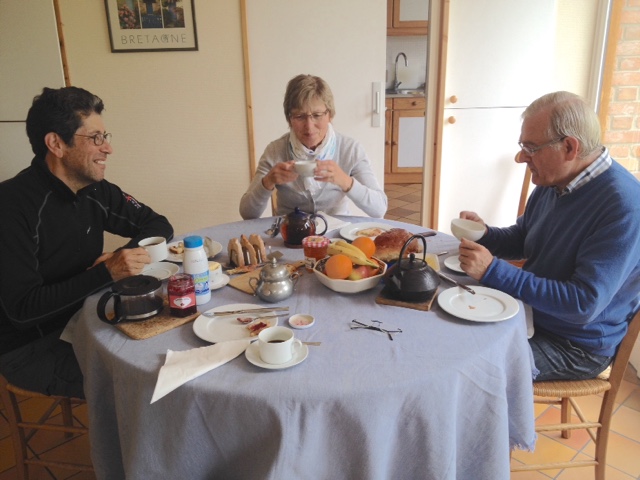
I've already told you about Beatrice and Paul and my detour to Dunkerque. Well, my wife, Carol, joined me for the last couple of weeks as we spent time with some of those people I've been telling her about. We spent several days with two really sweet people, Eva and Gösta, on their farm outside of Valberg, Sweden.   And a few more days with my good friend Nicolas, with whom I must have walked and shared dormitory rooms for at least two weeks in 2011, and his wife Lulu, whom he met that same year and with whom I also walked. We stayed with them at Lulu's parent's vacation home on the Bretagne coast. Their two young children, Paul and Louis, and Lulu's parents were also there.
Nicolas and I shared memories and some of the meaningful conversations that had marked our friendship on the road. I am so happy to see how life is working out for them. 

And then to Paris, where Carol and I were well looked after by Jean-Michel, who was Patrick's walking companion when I met him in 2012 and with whom I walked from Porto to Compostela last year, and by his wife Catherine, who is a lovely, kind woman, and who I met in Compostela when she joined Jean-Michel there after his walk. I caught up with Jean-Christophe, another Porto walking companion, and met his wife Areth at a dinner in Versailles hosted by Patrick and Colette. 

And Carol and I had dinner with our long term good friends Barbara and Jean-Philippe, full of vitality as always. So really very good to see them.

So the cold I experienced as I walked through the battlefields of the Somme has been eclipsed by the warmth of friendships renewed and maintained. 

I am ready to start walking again. 

Comments welcome at garyontheway@gmail.com

Wednesday, May 20, 2015

Regardless of loss

I did not see those words, "regardless of loss," until late in the day as I approached Peronne, but the phrase felt like the chill I had been feeling since I started out that morning. In Bapaume, the only tabac open early for a cup of coffee had been the one near the bus depot and opposite a gas station. I had dressed in my everyday hiking gear but the chill wind was too much for me to take. I grabbed my rain pants and headed to the WC to do a quick change. No rain was expected but I needed the rainwear to cut the wind. I added another two layers to the long sleeve hiking shirt I was wearing. My only hope for real warmth was to down some coffee and get walking. Neither helped. 

I told Patrick that I was missing not having met other pilgrims, and how walking the Via Francigena on my own would have been difficult. The Camino Frances doesn't present that particular challenge. There are tons of other pilgrims there, though it is easy to be alone in one's thoughts whenever one wishes and sometimes to be alone in body as well. Patrick is good company and a good friend, but we both miss being part of a community of walkers as we were in Spain. 

It wasn't just the just the chill and the low, slate-grey overcast, nor the aloneness. In the parts of France we had been walking through since Calais, there is a consistent narrative, towns and villages built and destroyed, rebuilt and destroyed again. The story there is written in conflicts with the English or Spaniards, with Flanders or Burgandy. To be sure, the two world wars also took a major toll. Even more recently, the destruction is economic and technological in origin. It is a region dotted by huge piles-become-hills and ridge-lines of coal mine tailings, now grown over with brush and trees to the point that they look like a part of the natural landscape.
From the time I left Arras, however, and especially as I walked from Bapaume to Perrone, the insanity of the Great War presented itself more acutely. You should be warned that my factual knowledge of WWI is limited. But this blog is about how I feel, and the few facts I have were engaged, that day, by that emptiness in the gut I got as I passed sign after sign —"South African Cemetery," "Australian Cemetery," "Manchester Cemetery." There are large national cemeteries in the area, but these burial grounds are smaller, at least the ones I saw are, memorials to a few dozen men, more personal, more heart churning than thousands upon thousands of white slabs or crosses. The small rectangularized arrows printed in neat sans serif, off white on green background, melded with the landscape in the same way those piles of tailings did, far too natural for my sensibilities.
Then I came to a sign, black on white, a German cemetery. The letters just felt harsher. That is not to say the German war dead do not deserve the same respect as the French and Commonwealth soldiers. Most, like their Ally counterparts, were not war makers, just more meat for the grinder. That sign, especially situated in front of the junked mechanical icon, that descendant on a different branch of the evolutionary tree from the Wotan A7V that saw action in 1918, a few dozen as armored fighting vehicles, several dozen more as troop carriers, was in no way natural.

On this part of the front, the region of the Somme, between 1914 and 1918, the German line advanced a mere 25 kilometers as measured by my thumbnail on a map I found a day or so later. How many bodies per kilometer, I wonder, in the taking and the losing.

My thoughts were lost in loss as I came upon two Aussies and a Brit walking the fields, tracing the movements in the Battle of Mount Saint Quentin, in the larger battle for Peronne. We chatted a bit. Not much about the war, but our conversation was quiet, respectful of where we were and what happened there. Not 100 meters after I left them, I came across a printed panel describing the action that took place there and the orders that had come down to take that strategic high ground overlooking Perronne, "regardless of loss."
I guess there are two ways to take that statement. A combat unit told that the only recourse for failure was death might not waver in the battle. They might understand the importance of their mission and vie more courageously for success. But that day, all I could think of was the other interpretation. What futility to know that if you were the last man standing you had better not stand for long despite the impossibility of odds. What hubris, to stand at the big chess board, moving men like game pieces, sacrificing pawns for a grander strategy. As it turns out, the Aussies won an important victory that day. As I understand it, they took the high ground and fought off German counterattacks. There were heroic actions by individuals, but there were also losses. 

The chill did not leave me all day.

Comments welcome at garyontheway@gmail.com

Wednesday, May 13, 2015

Omnes viae romam perducunt

I was amped coming out of Canterbury, disappointment over the lost miles evaporated, the only residue being what I noted in my journal, more intense and personal than what was posted on my blog. 

After Canterbury, I wanted to post something really upbeat and I owe it to some friends, who you will meet shortly, to do just that. But the mood turned a couple of days ago and I need to get that off my chest as well. So here is a quick summary of what went on in between. 


The first signs for Via Francigena reinforced my excitement. No longer heading to Canterbury - been there, done that. We are going to Rome. 


We take a path into Dover that avoids the muddied fields made squiggy under foot (real Brit-speak I picked up in Oxford a few years ago) by a sudden afternoon  downpour and enter Dover beside it's great fort overlooking the city. After descending to the city, we turn left and track beside white chalk cliffs fronted by transient hotels and boarding houses. Not surprising. The ferry terminal is just to the right. For some, their first footsteps in Britain are to a home in these ramshackles.  

The ferry is late due to bad weather over the channeI. I do not love boats of any kind, and the slight roll I feel as I walk across the cabin is not reassuring. Nor is there much to see in the haze that could distract me. But as we approach port, the sun peaks his nose, as Patrick would say, and voila!, France.

Our particular road to Rome takes us on an excursion to Dunkerque. Beatrice and Paul, who I met on the Camino Frances, meet the ferry. I introduce them to Patrick, and they open their home to us.


I met Beatrice and Paul early in my walk from Saint-Jean-Pied-de-Port to Compostela. They had already been walking a month. I did not know them but I shared some wine with them. Not so unusual on the Camino. I didn't see them again until a few days before my arrival in Compostela. At first, we did not recall having met earlier, though Paul, who has an excellent memory, eventually recalled the shared Rioja. For reasons of some walking slower and some faster, I had separated from the little community I was part of during my transit as they had from theirs. In this hostel, three days from our objective, we were each cooking our dinner and were left to eat alone. On a very small three sided table attached to a wall, we crowded together and ate, made conversation, and filled an emptiness we each were feeling. I shared an orange. Beatrice tells me she recalls that moment to this day.  Every time she eats an orange, she says, it tastes sweeter for that experience. She was a teacher, and is a sweet and giving person, as is Paul, who dedicated his career to people with mental disabilities. Now, in retirement, he is a rather accomplished artist. I cannot say enough good things about these two fine people.

Sunday afternoon, after a tour of the city, a visit to the cathedral to get our credentials stamped, and lunch cooked by Beatrice, they drive us back to Calais, near to where they picked us up. 
We begin our march through France from in front of Rodin's Burghers of Calais in situ. I enjoyed the next few days, the small country roads, the fields, and the vistas, not very different from what we experienced in England. Each gîte or chambre  d'hôte was unique and hospitable, but I want to end this post with our stay in Wisques at the little guesthouse outside the walls of the Abbey Notre Dame.
At the citadel-like abbey, home to a sisterhood of just 16, the last novice took her vows 15 years ago - religion, it seems, is no longer a growth business in France. But this Abbey holds a wonderful surprise outside its walls, a guesthouse that is every American's idea of France, presided over by the ebullient Sister Lucie, 50 years a resident at the abbey. Without her habit, she'd be mistaken for a most charming hostess of a country B&B. 
I've stayed in a number of abbeys, monasteries and parish houses during my walks and I am always struck by the obvious lack of funds these institutions must deal with. 
But in Sister Lucie's capable hands, the worn furnishings become a chic aesthetic.
Simple and comfortable, I was so taken by it that I must share more than my usual number of photos. 
The pleasant, flower emblazoned environment, was all the more special for what was to come. 
Soon after leaving, the weather turned chill and gloomy, as did my mood.  I stepped from spring to winter, for on this part of the road to Rome, ghosts stalk the wilds. I entered the region of the Somme. 

Constant Canterbury Part 2

Friday morning. An hour's walk to the train and a half hour later I am walking again. Skipping those miles gnaws at me. It's a pleasant enough walk - apple trees in bloom, wooded paths. Pleasant, it seems, just won't cut it today.

I pass the Blean, a large clearing in the woods that slopes up and to the right of me. It looks like nothing now, but two thousand years ago there was a Roman encampment and wooden fortification here. It is believed that it was erected by Caesar's legions as they made their way to the Thames. Interesting. 

We enter the outskirts of Canterbury and, though we have not walked the entirety of the Pilgrim's Way, I insist on entering on that route, avoiding several shorter alternatives. As we come to a crossroads where we must turn right, I am intrigued by the sight of a very old graveyard and church. I wander in and discover a treasure.

It is St. Dunstan's, where in 1174 Henry II removed his shoes, put on a rough woolen pilgrim's shirt, and walked barefoot to Canterbury cathedral in atonement for the murder of Thomas Becket, and where In 1577 Margaret Roper, daughter of Sir Thomas More, was interred along with the head of her father which she had rescued forty-two years before from a pike on which it was impaled outside the Tower of London on orders of Henry VIII. I've read about these events, seen dramas about them. As I stand in the Roper chapel, I see it peopled, not empty. I am ready to experience Canterbury. 

Exiting the church, a block or two ahead of me, a twin-towered fortified gate marks the entrance to Canterbury high street. Minus the modern infrastructure and it isn't hard to see what Chaucer's pilgrims might have seen. Vendor's stands fill the street, obscuring many of the building fronts. Street performers and hawkers, crowds of people sampling wares create a sense of hectic activity. The Wife of Bath would have been in her element. 

I've seen sights like this before but in Canterbury, today, it was special.
A left turn takes me to the cathedral precinct where, after waiting on a line to gain paid admission, I explain that I am only seeking a pilgrim's stamp for my credentials.

The magic words have been uttered. Patrick and I are whisked to a welcome center, no admission required. A young woman, Sarah, notes our packs. "I can tell you've been walking. Where did you start?" I show her our stamped credentials. "And how far are you going?" Holding my forearms out and perpendicular to my body, raising and lowering them slightly, "all the way," I say. Sarah squeals in an exclamative question, "To Rome?!" We nod.
Moments later, our credentials stamped, new ones bearing "peligrino francigeno" are issued, we are invited to attend Evensong, whisked to the cathedral for an admission-free tour, and introduced to a chaplain for a blessing. We wait for the reverend to climb down from the pulpit. He is a slight man but his grey hair, black robes and calm demeanor give him stature beyond the physical. 
"Reverend," I say, "I am not of your faith but I would appreciate your good wishes." He asks me what my faith is and what I believe. We speak for a while, and I tell him why I walk these millennia old paths, what I get out of them. He begins his blessing. He speaks of ancient covenants and promises fulfilled in modern times, of survival in the face of adversity, and of personal understandings yet to be gained. He speaks to me in English and in Hebrew, and I am touched by these accommodations.

What I find constant in Canterbury is its history and its sincere welcome. In the face of that, what are a few miles one way or the other?

Comments welcome at garyontheway@gmail.com

Friday, May 8, 2015

Constant Canterbury Part 1

I've struggled over the last few days. What shall I say about the walk? There's been some rain and lots of mud. There's been beautiful panoramas but little variance. I've met people I'd like to tell you about and perhaps I eventually will.

am now fourteen days into the walk, more than 200 miles and a channel crossing under my belt. I've already been walking in France for four days. Nothing seemed to rise to the level of blog-worthiness until about six days ago, the day before we entered Canterbury. It wasn't something I could easily write about until now because I am dead tired at the end of the day and I needed some time to understand how I am feeling about things. But I am ready now. 

So I will start with Constant. Every long walk has ups and downs and not just topographic. You deal with it. Sometimes, however, one of those downs threatens the walk itself. So it was in 2012, two days before Leon on the Camino Frances. My blisters had gotten so bad that my boots would no longer fit. I had lost one toenail and another was half ripped off. I could not walk. I could not go on. I was devastated. 

In the hostel that night, I met a Frenchman of African origin. He was a tall, robust man in his mid-sixties looking like fifty. His name was Constant. We spoke for a long time about the Camino. About the experience.  About the lessons one takes away. Finally, Constant looked at me with great seriousness and calmness. "Gary," he said, "disappointment is also a lesson of the Camino."

That didn't save the Camino for me. What saved it was my raison d'être telling me not to come home, to find a hotel room with a bathtub, and to spend the next two days soaking my foot.

That did the trick. On the third day, I walked just five miles, on the next ten. By the fifth day I was doing a slow fifteen, and with the swelling of my foot abating and the second toenail off (surprisingly a lost toenail is much less a problem than one in the process of being lost), I was back on the Camino.

That conversation with Constant, though, came back to me when Patrick and I finally had to face the one thing that threatened to destroy the enjoyment of this trip, and I remembered to accept  disappointment as a lesson, something to be embraced

Lodging has been the bane of this hike. The North Downs Way passes through or near few towns with any lodging. Where rooms exist they have been booked. I've spent hours every evening on the internet and the phone attempting to find rooms even if it meant taking a train to a bigger town or city and training back to our stopping point to pick the walk up where we left off. I've been so stressed that the enjoyment and benefits of the day's walks seemed to have evaporated. Everything was out of balance.

We were due to arrive in Canterbury on Saturday. On Thursday we figured we ought to find a place there and for an interim location the night before. No suitable accommodations were available. We'd have to spend hours at the task. I could not deal with it another time.

Finally, I offered the only solution that might bring things back in balance: train ahead by one day's distance and walk to Canterbury from that point, arriving on Friday when lodging was available. 

I was sorely disappointed not to walk the entire distance between Winchester and Canterbury, though we'd still be doing 144 of the 160 miles. Most of you will say this is a minor blip, something that will be lost in the context of a 1,400 mile walk. But for me, having set my sights on walking the entire distance, this was a big disappointment. 

For those who have not felt disappointment of this sort, I must tell you it is not an emotional thing. It is deeply physical. You feel it in the pit of your stomach or high up in your chest. It hurts. It pervades your thoughts. Everything which would otherwise be an excitement is degraded by the fact of having had to give up on an important part of the achievement. I know several good friends who would counsel that this is not failure, but it sure feels like it to me. It's how I am put together. 

This was the correct decision. It eliminated the stress but I still had to deal with the disappointment. Pilgrimage of this sort, though, is a long journey and opportunities to balance the disappointment do arise. Something always seems to come along which pays you back many fold.

And so it did as I arrived in Canterbury.

Comments welcome at: garyontheway@gmail.com 


Monday, May 4, 2015

Imperfection

Sometimes, the best of times, I find myself in a walking meditation. There is no control over what thoughts will emerge or what connections will occur, but the thoughts I have at these times are almost always important.

Today I thought of a good friend, newly made, who offered this wisdom when he read that I intended to blog: "perfection is an illusion." He knew I would try to write perfect posts and advised instead that I write from the heart.

Neurons flashed. Links were made. I was back at Winchester cathedral, my mind's eye on the floor tiles I had photographed the day before my walk began. They caught my attention then. Now I know why. Their beauty is in their imperfection.

I doubt these tiles are original. If they were, they would be 922 years old. Perhaps they are centuries old replacements, or recent replicas marred to look like those they replaced. What would those tiles tell me if they were perfect? Nothing. They would not tell me of the worshippers, penitents, tourists, and pilgrims, families and solo travelers, wanderers and wonderers, many thousands of them scuffing their way across those tiles or their predecessors in situ, over many hundreds of years. They would not tell me of marriages and births celebrated, or of the deceased remembered. The imperfections give these tiles character, tell of their history, and mark them unique. They are special because they are imperfect.

Everyone and everything each of us holds dearest in this world is imperfect in some way. They are what they are to us because of their imperfections, and often, the imperfections themselves are what we cherish most.

Thank you my friend for reminding me. 

Comments  welcome at garyontheway@gmail.com

Sunday, May 3, 2015

A day of firsts

Today in Guildford, I woke up to rain. It was my first but it wasn't the only first. I had my first great coffee (at Cafe Nero, the best, their advert claims, this side of Milan), first climb of any significance, first mud, and first blister. Patrick and I trudged up Pewley Hill to the North Downs Way (NDW), viewing rolling hills draped in fog. 
Up to St. Martha's-on-the-hill, where the verger gave us the local history of dukes and the villages they relocated for their convenience, of brick-built Norman churches torn down and reconstructed in stone, as the duke thought a proper Norman church should be. He showed us the grave of Irving Bloomingdale of NY department store fame, who loved the place, and who was buried there when he died nearby, "though there are two stories about his death," the verger gossiped. 

He described how the Pilgrim's Way is a "bit of Romantic fantasy," whereas  the NDW, called by locals the Harrow Way or the Old Way, is Neolithic, and part of the migratory route from the continent that brought human settlement to Britain across the land bridge that would later become the English Channel at the end of the Ice Age. The Way went on to the Southwest, the opposite direction of my travel, past a Stonehenge yet to be built. Those migrants did not create the road - it was an animal track long before humans ever used it. 
The English do love their rain. Katey was a check-in point for an orienteering exercise, and I met many, many pups (my term for any dog that does not attempt to make a meal of me) giving their symbionts their required exercise. One lovely young springer was accompanied by a butterfly-observing woman who kindly gave me and Patrick directions to Dorking after we'd left the NDW to find rooms for the night. 
I met only one other pilgrim along the route, but he was taking his time, enjoying the English weather. 

Comments are welcome at garyonthe @gmail.com

Friday, May 1, 2015

The journey begins

My good friend, Patrick, who I met on the Camino Frances in 2012, flew to London to join me on my adventure. We trained it down to Winchester and headed to the cathedral to obtain our credentials, the booklet in which one accumulates stamps from churches, places of lodging, and villages along the trail. 
The verger was surprised and delighted to meet two pilgrims walking to Rome. He arranged our credentials and wished us a blessed journey. Whatever one's beliefs, the good wishes of others are always welcome.
After our stay at the well-worn Ranelegh guesthouse, Thursday morning dawned bright and dry, not a cloud to mar the cerulean sky, despite rain having been forecast. A bracing 3 degrees Centigrade, 37 Fahrenheit.
We walked along wooded footpaths and through wetlands and meadows. We were greeted by nearly newborn lambs, four pigs named Parsley, Sage, Rosemary and Thyme (yes, really - there was a sign), and an octet of gambolling young cows that seemed to play a game of tag with us, romping ahead some 20 meters until we caught up with them, repeating their game some four or five times. 
It all seemed quite idyllic until we realized that the GPS track we were using had been constructed, not by walking, but on a map, using many long straight lines. Our path, instead, zigzagged, increasing our distance to a leg-straining 26 miles, eight more than planned. We arrived in Alton, of Jane Austen fame, dragging our sorry selves to a shower, a juicy hamburger, and a couple of welcoming beds. What a pleasure to be on the trail again with aching feet, a sore back, and nothing on my mind outside the cast of my own shadow. 

Monday, April 27, 2015

12 KG plus H20

Packed and ready to go. Its a bit heavier than I would like – just under 12 KG/26 lbs – plus water at another KG per liter. But it does contain consumables, including a pound of trail mix. I will be munching and sipping my way to a lighter load.

My itinerary will follow St. Swithun's Way and the North Downs Way to Canterbury and, from there, the Via Francigena, as documented by Sigeric the Serious circa 990. It was, already at that time, a route that had been followed for several centuries, first referred to as the Lombard Way and later, the Iter Francorum.

My route this year: Winchester - Canterbury - Dover - Calais - Reims - Besançon - Laussanne - Hospice Grand St. Bernard.

Weather forecast: mud!

Off to Heathrow.


Thursday, April 16, 2015

Crossing the Pyrenees


One day in 2009, I decided to take a walk. It's lasted a little longer than originally intended: Four month-long journeys, over four years from Lindau Hafen am Bodensee to Santiago de Compostela, another year from Santander to Compostela, last year from Porto. It wasn't until the third year of walking that I considered myself a pilgrim thanks to three little slips of paper I had taken from the cathedral at le Puy en Velay. I thought they were meant to give me encouragement should I flag en-route to St. Jean Pied de Port. I flagged. I read. No ¡Andale! for Gary. No ¡Vamos! for sixty-one-year-old blistered feet, short a few toenails. They were prayers, two in French, one in German, left by those who could not do the walk, asking for the recovery of a loved one stricken by cancer, harmony in the workplace, and peace for a troubled mind. No big requests. No "world peace." Just simple human hopes. I had no choice. I continued to St. Jean Pied de Port. I carried those prayers home with me to California and back again to France the following year. I walked them over the Pyenees, along the Camino Frances, from one end of Spain to the other. It did not matter that my faith is different from those who penned those pleas. I delivered them to where they were intended to be delivered, to the cathedral of St. James. My walk became a pilgrimage on behalf of others, and, by virtue of many hours of walking meditations, friendships made, and moments of synchronicity, a pilgrimage of my own. I guess my walk is not yet finished. (Photo: May 2012 between St. Jean Pied de Port and Roncesvalles)